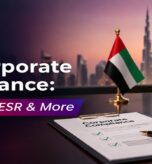
Getting the trade licence helps you start a business in the UAE. However, it’s the corporate compliance that keeps the business running without a hitch. Meeting all the necessary corporate compliance requirements in the UAE can be tricky, especially if you are managing multiple tasks.
That’s why we have created this post to help you understand the 3 important regulatory compliance areas in the UAE: UBO, AML, and ESR. MICS International is here to help you understand and maintain compliance for your business. Contact us to learn more.
What Is Corporate Compliance In The UAE?
Corporate compliance refers to a set of legal, regulatory, and procedural obligations a business must fulfil to operate lawfully within the UAE. These compliance requirements could focus on the business ownership structure, transparency of financial documents, and their contribution to the UAE’s ecosystem.
All businesses across mainland, free zone, and offshore must follow the corporate compliance requirements to continue their operations. However, the specific list of compliance requirements varies based on industry, jurisdiction, business structure, and trade licence activities.
The free zone companies might have to comply with regulatory requirements from the free zone authority. Therefore, before choosing the free zone and business activities, check what corporate compliance you need to meet.
What Is The Purpose Of Corporate Compliance?
Corporate compliance in the UAE serves a strategic purpose of building a transparent, trusted, and well-managed global business hub.
UAE corporate compliance is important to:
- Stop money laundering and terrorist financing and tax evasion
- Improve transparency of ownership and control of companies
- Ensure businesses have real economic activity within the country, not just a registered address
- Safeguard UAE’s position on international financial watchlists
- Gain the confidence of banks, investors and global trading partners
3 Important Regulatory Compliance In The UAE
The following are the 3 common corporate compliance requirements in the UAE that each business must follow. These three compliances focus on the core business areas: ownership, finances, and business activities.
Ultimate Beneficial Owner (UBO)
UBO compliance in the UAE requires businesses to disclose the names of individuals who directly or indirectly control the business. Cabinet Decision No. 109 of 2023 mandates all businesses in the mainland and free zones to register and keep a record of the owners, partners, shareholders and nominee directors.
In the event of a change in the shareholding or control of the business, the relevant authority should be updated immediately. In the UAE, non-compliance with UBO regulations may be a warning or an admin fine of AED 100,000.
Ultimate Beneficial Ownership (UBO) Compliance Services in the UAE by MICS International:
- UBO Identification and Assessment
- UBO Register Preparation
- Shareholder Structure Analysis
- Regulatory Filing Support
- Compliance Documentation Management
- Ongoing UBO Compliance Monitoring
Anti-Money Laundering (AML) & Counter-Terrorist Financing (CFT)
AML compliance in Dubai is essential for businesses to prevent financial crimes. Compliance is about establishing policies, carrying out regular due diligence and reporting suspicious business transactions to the appropriate authority. To this end, a business has to hire an AML Compliance Officer.
AML and CFT compliance is mandatory and strict for Designated Non-Financial Businesses and Professions (DNFBPs) such as real estate brokers, dealers in precious metals/stones, corporate service providers, trust companies, and independent accountants.
AML and CFT non-compliance can result in administrative fines ranging from AED 50,000 to AED 5,000,000 and strict license suspension.
Anti-Money Laundering (AML) Compliance Services in the UAE by MICS International:
- AML Risk Assessment
- AML Policy Development
- Customer Due Diligence (CDD) and KYC
- AML Compliance Framework Implementation
- Suspicious Transaction Reporting
- AML Training and Awareness
- AML Audit and Review
Economic Substance Regulations (ESR)
The ESR in the UAE is focused on certain business segments. Businesses will be required to submit ESR notification or ESR report which will contain their relevant activities with economic substance. This compliance is designed to ensure that businesses have a local presence and contribute to the economic growth of the UAE as well.
ESR non-compliance in the UAE can lead to a penalty of AED 50,000. If the non-compliance continues, this fine can escalate to AED 400,000.
Economic Substance Regulation (ESR) Compliance Services in the UAE by MICS International:
- ESR Applicability Assessment
- ESR Notification Filing
- ESR Report Preparation and Submission
- Economic Substance Evaluation
- ESR Documentation Support
- ESR Compliance Advisory
Corporate compliance in the UAE is critical for your business’s survival. Therefore, in addition to these three compliance areas, MICS International also helps you with Corporate Governance Compliance, Risk Management Reviews, Regulatory Reporting Support, Compliance Training Programs, Compliance Policy Development, Internal Compliance Audits, and Regulatory Inspection Support.
Ensure Business Compliance In Dubai With MICS International
Hundreds of businesses have trusted us to meet corporate and regulatory compliance needs in Dubai. Here’s why they continue choosing us:
- Reliable compliance solutions tailored to your business and industry
- Team of experienced professionals helping clients navigate complex compliance rules
- Building and implementing an auditing and compliance framework
- Avoid regulatory penalties and fines with timely compliance
- Stay updated on changes in regulatory compliance policies
When you choose us for compliance, you can focus solely on business growth while we ensure that all regulations are met. Contact us to learn more.
Conclusion
Corporate compliance in the UAE is an ongoing commitment for businesses. Business compliance encompasses several laws which serve to ensure the legitimacy and productivity of a business. One category of compliance, UBO, covers the rules relating to business ownership and control. AML & CFT concerns financial compliance through the maintenance of business transparency. Finally, ESR applies to business compliance regarding its presence in the United Arab Emirates. MICS International is here to help you meet these three and other regulatory compliances efficiently while you focus on business growth. Contact us to discuss more.
FAQs
How many types of compliance are there?
The types of compliance in the UAE market depend on your jurisdiction, business activities, and the industry. However, the three common compliances that each business must follow are UBO disclosure, AML/CFT obligations, and Economic Substance Regulations (ESR). Furthermore, you also have to meet VAT compliance requirements.
What is AML compliance in the UAE?
Anti-Money Laundering (AML) compliance in UAE is all about spotting and stopping financial crimes, terrorist financing, and illegal financial activities. Some of the AML compliance activities include policy development, due diligence, implementation of AML compliance framework and risk assessment.
What is ESR filing in the UAE?
The ESR filing in the UAE is essential for some businesses to indicate that they are conducting certain business or economic activities in the UAE. Some business activities included in ESR filing are hiring local staff, banking, and other on-premises activities.
Is auditing mandatory in the UAE?
The compliance for auditing in your UAE business is subject to the jurisdiction, business structure and business activities. Many LLCs and free zone companies are required to have an annual audit. Auditing differs by industry, too. Contact us to find out if your company needs a mandatory annual audit.